
History page 4
English Churches were members of the “Women’s Christian Temperance Union which was carrying out excellent work. Temperance meetings were occasionally held in Temperance meetings were occasionally held in poor localities and for European Pensioners and others. Two Bands of Hope worked among the children. Mention must be made of the Civilian Branch of the Royal Army Temperance Association initiated during the year to fight against the evils of drinking.
The care and concern of the Church extended to the “poorest of the poor English speaking community”. The Eurasian problem was a difficult one, and the Church began with the children, hoping that this would help in finding a solution. This concern for a poor and neglected community also gripped the heart of one of our former pastors, the Rev. D. Irving who served our Church for 22 years. The report also mentions with sadness, the “lamentable lack of earnestness” among many who on several occasions made promises of loyal and continued services, but who now revealed an apparent indifference to the claims of the Church.
1903-1904
A time of growth and consolidation. A revival meeting held early in 1904, seemed to give the much needed quickening in the English Churches, but its good effects seemed to be short lived. In all the English churches, special efforts were made to revive the languishing Class meetings, and efforts to improve the attendance of the week evening services, was in some measure a success.
The St. John’s Hill pastorate had the Rev. F. G. Grey during 1903, but in 1904, it was without a pastor, except so far as the East Parade Minister could give his time to the work here. However, the Sunday congregations remained the same and the weekly evening services were well attended. The work suffered a heavy loss in he death of Mr. Donaldson who was a local preacher “of no ordinary lucidity and power”. As steward and Sunday School Superintendent, his services seemed indispensable to the work of the Church. The Sunday School of the St. John’s Hill Church was growing in numbers and here as in East Parade, there was the need for a closer union between the school and the church. The services conducted in the Pensioner’s Rooms were well attended.
1905-1906
Our pastor in 1905 was the Rev. John F. Rielly, a devoted student of Kannada, whose time was divided between the Church and his scholarly pursuit. The spiritual need of the Church was identified as “our first care”. What followed was an increase in the Sunday Services and the Class meetings.
The services in the Pensioner’s Rooms were twice discontinued on account of the prevalence of plague in the neighbourhood. Despite much sickness amongst the members, the Church was often cheered by “definite conversions” increasing
members and by the visible signs of earnestness in the pursuit of good, on the part of many.The year 1906 opened with the unexpected transfer of the Rev. Reilly from St. John’s Hill to Kolar and the appointment of the Rev. Arthur R. Slater to our Church. The English circuit was heavily stricken with a number of deaths, and the Church seemed permanently the poorer, however “all had died well, and the Church glorified God in them.”
At St. John’s Hill, there were no definite cases of conversion. The form of the Class meetings were altered, and attendance greatly improved. It was the sincere desire of the Church to make the Class meetings a place for enabling a deeper study of the Bible and promoting fellowship for prayer, a sure means of strengthening the life of the Church. The Sunday School continued to be well staffed with earnest workers.
WHITEFIELD MISSION
What was noteworthy in 1907 was that the Non- Conformist population of the Whitefield settlement requested the Wesleyan Methodist Mission to take oversight of their spiritual needs and to include them as a part of the Methodist Church. Every Sunday, a preacher either lay or ordained was sent out to conduct the service in a building used both by Non-Conformist and the Church of England congregations. The work in St. John’s Hill continued in the ‘even tenor of its way’, with its routine of services. In the month of August, 1907 a course of Lantern lectures were arranged instead of the week night services. The course consisted of lectures on Dr.Paton, Missionary to the New Hebrides”, Bunyan’s “Pilgrim Progress”, “The Holy War” and “A Hindu Village Festival.”
CONSECRATED SELF-HELP
In 1910, the St. John’s Hill Church witnessed a steady growth of workers, deeply committed to the various agencies of work in the Church. The old dependence upon the minister to bear all the burdens of the church was fast giving way to “a consecrated self-help”. It is to the Wesley Guild that we owe this great debt of promoting fellowship in the Church and preparing the leadership for the future of the Church
Another noteworthy features of the year, was the increased spirit of liberality. “Our people gave well.” A large sum was raised to install the electric lights in the Church and Guild Room.
THE CHILDREN’S WINDOW
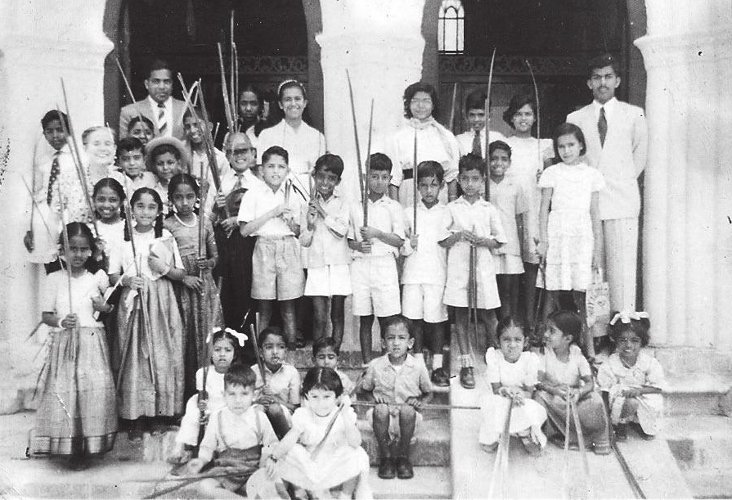
The Work in St. John’s Hill had really prospered considerable by 1911. The interior of the Church was cleaned and beautified. One of the new coloured windows was to be called in the future “The Children’s Window.” as it was renewed by money collected for the purpose by the Sunday School, a most valuable institution of the
Copyright © 2018 - Wesley English Church